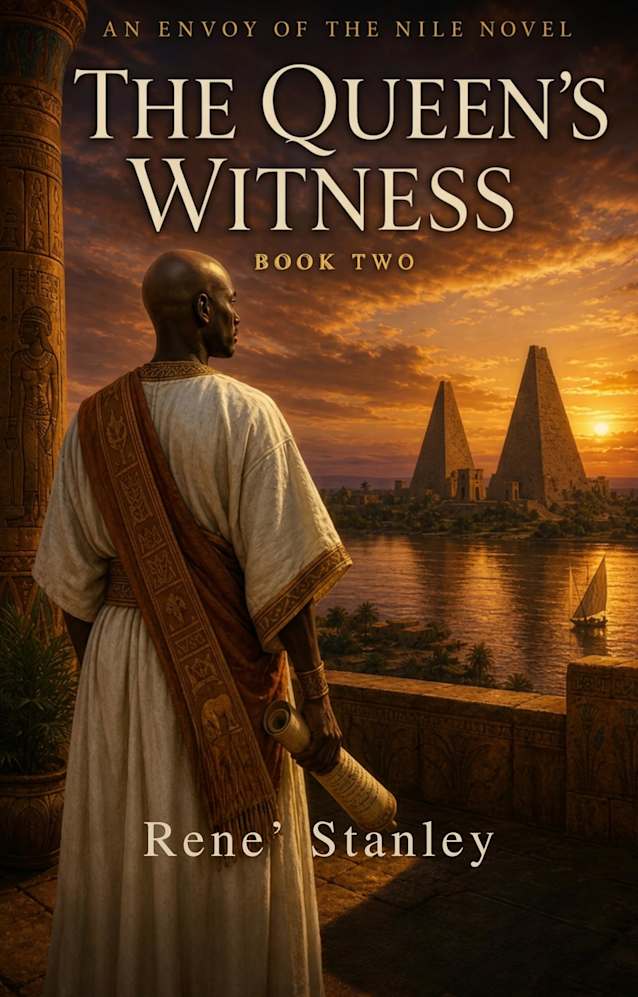
The Queen’s Witness: An Envoy of the Nile Novel (The Envoy of the Nile Series)
About
The gold of Kush travels north by tribute route. So does secrets — if you know how to move them.
A eunuch treasury official and secret Christian, Simeon of Meroë has barely returned from Jerusalem when the Kandake summons him to a second investigation: a senior customs official is dead on the southern road, and the iron tribute shipments from the smelting yards have been falsified for seven months. The sand filling the strongboxes tells Simeon that someone with deep knowledge of the kingdom’s authorization system is skimming the royal treasury — and has chosen murder over exposure.
But the investigation refuses to stay simple. The palace official assigned to observe Simeon’s inquiry is courteous, thorough, and positioned at every turn to redirect the truth. A burned set of clay tablets beneath the body holds the shadow ledger of a careful, faithful man. And the small Christian community Simeon leads — fragile, unauthorized, alive — is suddenly entangled in the fraud through the very routes they used to carry the teaching south.
When his closest soldier vanishes under suspicious circumstances and a young Greek believer is taken by someone who needed a lever, Simeon must choose between the speed the Kandakes deadline demands and the care that justice requires. He has ten days. He has a community he cannot protect by lying for them. And he has an investigator’s faith in one thing above all: that the figures will resolve — if he checks them twice.
The Queen’s Witnessis the second novel in The Envoy of the Nile, a Christian historical mystery series set in first-century Nubia.
Praise for this book
Reminded me that finding the truth is not always the same as finding one person to blame.
The Queen’s Witness by Rene’ Stanley is the kind of book that makes you realize that a missing amount of gold can cause a surprisingly large amount of trouble. At first, the story seems to be about a murder and some suspicious accounting, but it quickly becomes much more complicated. What I liked most about the book is that it does not rely on nonstop action to keep things interesting. Instead, the tension comes from people watching each other, hiding information, and trying to figure out who can actually be trusted. Simeon is probably my favorite character because of how seriously he takes the truth. He is not the type of person who jumps to conclusions just because something looks suspicious. He studies the numbers, notices patterns, and waits until the evidence makes sense. His investigation begins when he notices that iron shipments have been consistently recorded slightly lower than they should be. Then Pakhom is found murdered, his strongboxes contain sand, and the investigation starts pointing toward something much bigger. One thing I especially enjoyed was how the author uses small details to create suspicion. Simeon notices things that other people might completely ignore, such as missing records and even a disturbed iron weight. Those details may sound boring on paper, but in the story they become clues. I found myself paying attention to little things because I knew they might matter later. Basically, the book teaches you that apparently even a misplaced object can have a criminal résumé. The characters also make the story more interesting. Djethor is particularly fascinating because he is polite, intelligent, and extremely helpful—but that somehow makes him more suspicious, not less. His evidence against the Tarif clan is real, yet Simeon realizes that it only shows part of the truth. The book makes an important point here: something can be completely true and still be misleading if important information is left out. I also appreciated the emotional side of the story, especially Simeon’s relationship with Aman and the community. The book is not only concerned with discovering who committed a crime; it is also interested in questions about belonging, forgiveness, loyalty, and what people do after they have made serious mistakes. The final scenes involving Aman are especially meaningful because his progress is shown through a small action rather than some dramatic speech. He literally moves away from the wall and closer to the community, which says a lot without needing to explain everything.
A mystery that kept me turning the pages
Reviewed in the United States on October 2, 2026
This was a gripping read for me that had me eager to keep turning the pages…The storyline follows a customs official who’s been murdered and royal tribute records are discovered to have been falsified, Simeon is given only ten days to uncover who is stealing from the kingdom. The Queen’s Witness follows Simeon of Meroë, a eunuch treasury official and secret Christian serving the Kandake of Kush. I liked how the mystery mixes political intrigue, ancient Kush, and Simeon’s faith without making the investigation feel too predictable. The details about the trade routes, burned clay tablets, and the small Christian community added a lot of atmosphere.
A good imagining of the Ethiopian eunuch
Reviewed in the United States on September 30, 2026I really enjoyed A Name Better Than Sons by Rene’ Stanley. It was a good mix of history, faith, mystery, and the struggles that come with trying to figure out where you belong.
I really liked Simeon and how the author took the Ethiopian eunuch from Acts 8 and gave him a name and a story. His struggles with being accepted and trying to find his place really made me think about how many of us have felt like we didn’t quite fit in at one time or another.
The part about Isaiah 56 and having “a name better than sons and daughters” really stood out to me. I liked how that verse kept coming back throughout the story and how much it meant to Simeon. It made the title make so much more sense.
I also enjoyed the mystery surrounding the deaths in Jerusalem. Simeon’s ability to notice things that other people overlooked made his investigation interesting. I liked how the story showed that sometimes people can take their beliefs and traditions so seriously that they lose sight of what God is really asking of them.
One thing I really appreciated was that the early church wasn’t portrayed as perfect. There were disagreements, prejudice, fear, and people struggling to understand who should be welcomed. I think that made the story feel more real.
Overall, I thought this was a really good read. It kept me interested because of the mystery, but it also made me stop and think about faith, acceptance, and what it really means to belong. I would definitely recommend it to anyone who enjoys Christian historical fiction with a good mystery and a deeper message.
A Vivid, Immersive Historical Adventure with Heart, Intrigue, and Remarkable World‑Building
Reviewed in the United States on September 30, 2026The Queen’s Witness is one of those rare historical novels that pulls you in from the first chapter and won't let go. It’s richly detailed, emotionally layered, and full of the kind of political intrigue and cultural depth that makes ancient‑world fiction feel truly alive. This book doesn’t just tell a story — it transports you.
The world‑building is exceptional. Every scene feels textured and intentional, from the bustling energy of the Nile to the quiet, dangerous corners of royal courts where alliances shift like sand. The author has a gift for weaving history, myth, and human emotion together in a way that feels both authentic and cinematic. You can practically smell the incense, hear the river, and feel the weight of every decision the characters make.
The characters themselves are unforgettable. The protagonist is sharp, observant, and deeply human — someone caught between duty, loyalty, and the moral cost of witnessing too much. The political tension surrounding the queen, the shifting loyalties, and the subtle power plays all add layers of complexity that make the story incredibly engaging. Every relationship feels meaningful, every conversation loaded with subtext.
The plot moves with a perfect balance of suspense and emotional depth. There are moments of quiet reflection, moments of danger, and moments that feel almost breathtaking in their intensity. The mystery at the heart of the story unfolds with satisfying precision, and the stakes feel real from beginning to end.
What I loved most is how The Queen’s Witness blends historical authenticity with modern readability. It’s smart without being dense, lyrical without being heavy, and full of heart without ever sacrificing tension. It’s the kind of book that makes you want to learn more, think deeper, and immediately reach for the next in the series.
If you enjoy immersive historical fiction with strong characters, political intrigue, and beautifully crafted world‑building, this novel is an absolute standout—a true five‑star read.